
|
||
Nested Finite Volumes in MALZThe recent enhancement of the MultiGroundZ module introduces support for nested finite volumes, enabling significantly more efficient and intuitive modeling of complex grounding environments containing heterogeneous soils and engineered materials. The new capability allows users to define finite volumes directly within enclosing host volumes, eliminating the cumbersome manual subdivision previously required to represent embedded regions. The following figure shows a typical scenario where a volume is nested inside another volume. 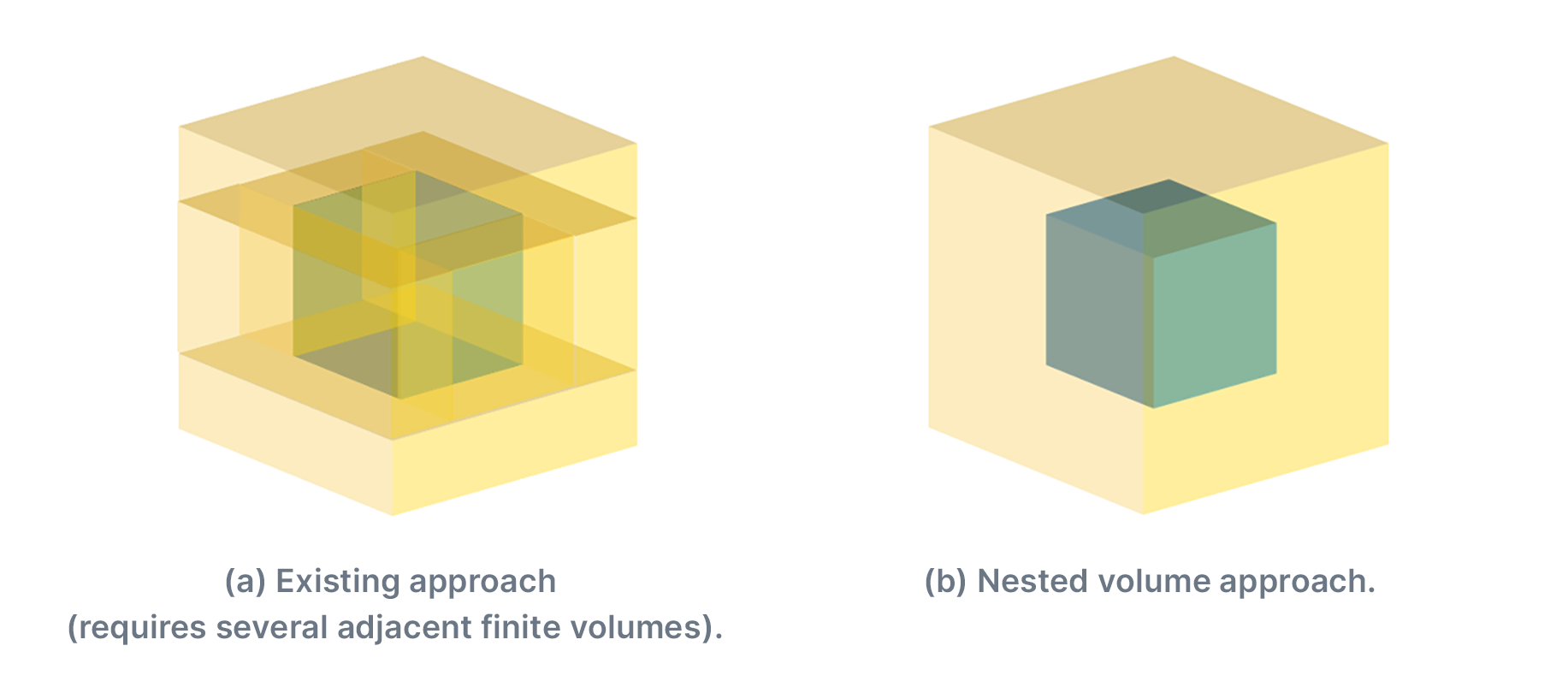
Typical nested finite-volume scenario: (a) existing approach, where multiple (i.e., 7) adjacent volumes are created and (b) enhanced approach, using a nested volume. Part (a) represents the same physical configuration using the traditional approach: the embedding region is decomposed into six homogeneous volumes that must be defined in contact with one another and with the inner (embedded) volume. With the new enhancement, the model can be built much more directly by inserting the inner volume inside the outer volume, while the solver handles the interaction across all interfaces. This simplified representation is shown in part (b), where only two finite volumes, one nested inside the other, are sufficient to model the system. The following figure shows a representative case, an elevated backfill system with bentonite inclusions surrounding the grounding grid. The enhanced approach significantly reduces the number of required finite volumes (four instead of eleven) while producing results closely matching those obtained using the traditional multi-volume contact approach. 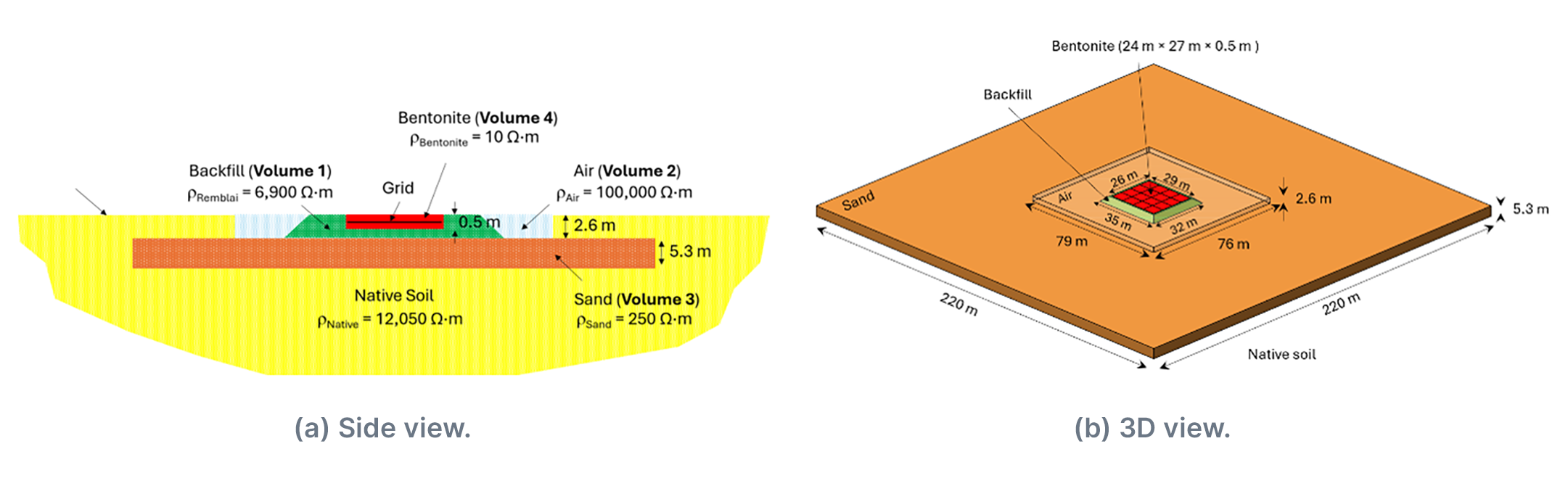
Finite volume model of backfill with bentonite See the article entitled “Nested Finite Volumes in CDEGS” in these Proceedings for further details. |
||
|
||
|
SES & technologies ltd. 3055 Blvd. des Oiseaux, Laval, Quebec, Canada, H7L 6E8 +1 (450) 622-5000 info@sestech.com ©2026 SafEngServices & technologies ltd. |